
 English
Protecting the Evidence That Proves Your Uber Crash Claim
Key Takeaways: A rideshare accident spoliation letter is a written demand telling Uber, the driver, insurers, and other custodians to stop routine deletion and preserve everything tied to your crash. Sending one quickly matters because Uber crash evidence is mostly digital and perishable, with dashcam loops, phone records, and app data potentially disappearing within hours, days, or weeks. To send one properly, identify every party who may hold evidence, describe the categories with precision, and deliver it by certified mail with return receipt so delivery can generally be proven later. One of the most critical items to request is driver app status at the moment of impact, because Missouri’s tiered TNC insurance requirements under Mo. Rev. Stat. § 379.1702, together with the personal-policy exclusions permitted by Mo. Rev. Stat. § 379.1708, may determine which policy applies. Missouri generally does not recognize an independent spoliation tort, so leverage typically comes from evidentiary consequences, including an adverse inference that holds the spoliator to admit the missing evidence would have been unfavorable, though Missouri courts generally require a showing of intentional destruction indicating fraud or a desire to suppress the truth. Missouri’s five-year filing deadline under Mo. Rev. Stat. § 516.120 applies to many but not all injury claims and is generally far longer than the evidence clock, so it is often wise to treat preservation, not filing, as your real deadline.
After a serious Uber crash in Kansas City, the evidence that matters most often is not sitting in a police file. It may live on servers, phones, and in-vehicle computers that can be overwritten or wiped clean within weeks. A rideshare accident spoliation letter is a written demand telling Uber, the driver, and other involved parties to stop routine deletion and hold onto everything connected to your collision. Sending one early can be the difference between a claim backed by hard data and one that comes down to one person’s word against another’s.
If you or someone you love was hospitalized after a crash on I-29, Barry Road, or anywhere in the Northland, our team at Ley de lesiones de Northland can help you get a preservation demand out quickly. Call us at 816-400-4878 o reach out to our team now to talk through what happened. We will talk with you, not at you.
What a Spoliation Letter Actually Does
A spoliation letter puts a company on formal notice that specific evidence should be preserved because litigation is reasonably anticipated. It is not a lawsuit and does not require a judge’s signature. It is a documented request that may make it harder for a defendant to later characterize deletion of relevant records as innocent housekeeping.
Missouri handles this issue through evidence rules rather than a separate lawsuit. Missouri has not recognized spoliation, intentional or negligent, as a basis for tort liability against a party or non-party. Instead, destruction is addressed within the underlying case. Missouri’s evidentiary spoliation doctrine generally applies where there is intentional destruction indicating fraud and a desire to suppress the truth, and this showing is the threshold requirement before any spoliation remedy may be invoked.
Available remedies may include an adverse inference argument, preclusion of the offending party’s evidence, and an "admission" against that party, although a jury instruction on spoliation has not been approved under Missouri case law. Your leverage generally comes from what a judge may permit you to argue, not from a separate claim for damages.
The duty to preserve can matter before anyone files suit. Legal commentary examining Missouri spoliation procedure discusses how a party’s obligation may arise once it knows or should know evidence could be relevant to a potential claim. Where an alleged spoliator knew or should have known of this duty, destruction may give rise to an inference of fraud. A clear written notice is often what helps establish that knowledge.
Why Rideshare Cases Demand Faster Action
Uber crash evidence is unusually perishable because most of it is digital and controlled by a company headquartered thousands of miles from Kansas City. Trip logs, GPS pings, driver app status, ride timestamps, and in-app messages typically sit on corporate systems governed by internal retention schedules. Dashcam footage can be worse, since many consumer cameras overwrite themselves on a loop measured in hours or days.
Rideshare volume also carries measurable safety consequences. Peer-reviewed research on Uber and traffic fatalities published in the Review of Economics and Statistics found that the introduction and expansion of ridesharing is associated with a decrease in overall traffic fatalities, reducing U.S. traffic fatalities by approximately 5.2% in areas where it operates. That national finding does not decide any individual case, but it explains why careful documentation in rideshare collisions deserves real attention.
The same urgency applies in trucking cases, where electronic data can disappear just as fast. For broader background, our overview of what a spoliation letter is covers the same concept in a commercial vehicle context.
How to Send a Spoliation Letter After an Uber Collision
The process is generally straightforward, but details can determine whether the letter holds up later.
Step One: Identify Every Party Who Holds Evidence
Uber is rarely the only custodian. A complete list usually includes the rideshare driver personally, Uber’s legal department and registered agent, the driver’s personal auto insurer, the rideshare company’s commercial carrier, any other at-fault motorist, the towing or storage yard holding the vehicles, and the responding law enforcement agency. Each may control a different slice of the record.
Step Two: Describe the Evidence With Precision
Vague demands can invite vague compliance. A strong preservation letter generally identifies categories specifically:
- Driver app status data showing whether the app was off, awaiting a match, or engaged in an active trip at impact
- Trip records, GPS coordinates, route data, and ride acceptance/completion timestamps
- Driver cell phone records, call logs, and text activity around the collision time
- Event data recorder ("black box") downloads and any dashcam or telematics footage
- Driver background check files, prior complaints, deactivation history, and hours logged that day
- Vehicle maintenance/inspection records, plus the physical vehicles in unrepaired condition
Step Three: Send It in a Way You Can Prove
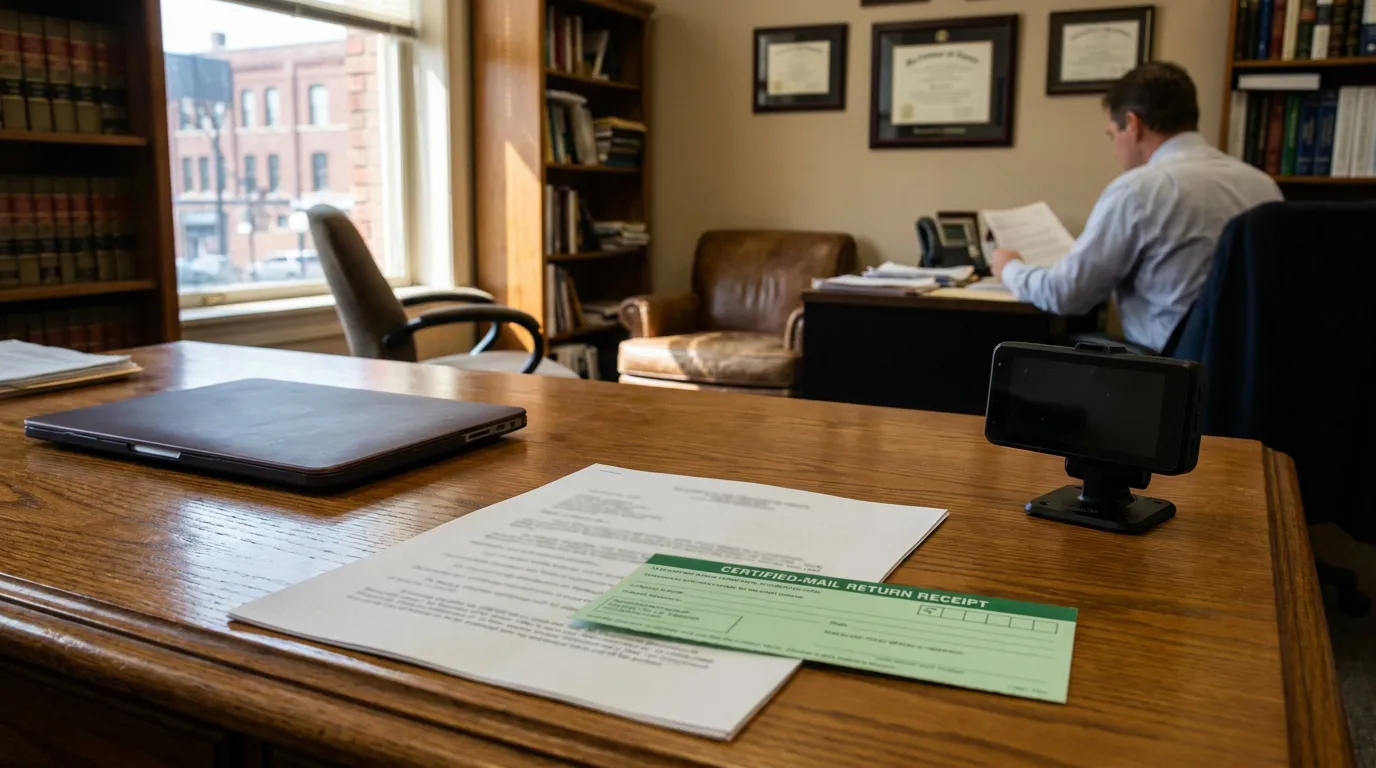
A certified mail spoliation notice with return receipt requested creates a paper trail you may need months later. Many attorneys also send duplicate copies by email and through the registered agent on file with the Missouri Secretary of State. Keep every receipt, tracking number, and delivery confirmation in your file.
💡 Pro Tip: Photograph the sealed envelope and the certified mail receipt before you drop it off. If a defendant later disputes when notice arrived, that timestamped image may help settle the argument.
Why App Status Drives Everything in Your Claim
One of the most valuable data points in an Uber crash can be what the driver’s app was doing at the moment of collision. Missouri’s Transportation Network Company provisions set TNC insurance requirements that vary by the driver’s period of activity. While logged on and available but not engaged in a prearranged ride, the statute requires primary liability coverage of at least $50,000 per person, $100,000 per incident, and $25,000 for property damage, plus uninsured motorist coverage; while engaged in a prearranged ride, at least $1 million in primary liability coverage applies, under Mo. Rev. Stat. § 379.1702. Separately, Mo. Rev. Stat. § 379.1708 permits personal auto insurers to exclude or limit coverage for losses occurring while a driver is logged on to a TNC’s network or carrying passengers for compensation. Coverage during an active trip may therefore be dramatically different from when the app is off entirely.
| Driver Period | What It Means | Coverage Generally at Issue |
|---|---|---|
| App off | Driver is off duty | Personal auto policy only |
| App on, awaiting a match | Logged in, no passenger | Lower contingent TNC limits |
| En route to rider or on trip | Match accepted or passenger aboard | Full commercial TNC coverage |
Because this classification can affect which insurer pays and what limits apply, your preservation demand should generally request records that may establish app status at the time of impact. Actual coverage still depends on specific policy language and endorsements. Insurers sometimes dispute the period, and without underlying data, that dispute may become difficult to resolve in an injured person’s favor.
The Distraction Question Most Letters Miss
Rideshare drivers interact with a navigation and dispatch app while driving, making phone evidence unusually relevant. Federal safety guidance on distracted driving identifies texting, phone conversations, and navigation use among common distractions, and reports national statistics on distraction-affected crashes and fatalities.
Carrier records are typically retained only for limited windows, and drivers can delete messages within seconds. A preservation demand naming phone logs, app notifications, and in-app communications may give you a documented basis to seek that material in discovery later, subject to the privacy objections and discovery limits a court may impose.
Documenting Your Own Side of the Record
Preservation runs both directions. Save your Uber trip receipt, ride screenshots, and the driver’s name and vehicle information before anything gets archived in your account. Photograph your injuries over time, keep every discharge instruction, and hold onto damaged property. Under Mo. Rev. Stat. § 516.120, Missouri’s five-year window also covers actions "for taking, detaining or injuring any goods or chattels," which is one reason your damaged vehicle and its onboard data should generally stay untouched if practical.
Deadlines, and Why Five Years Is Not as Long as It Sounds
Missouri generally allows five years to file many personal injury lawsuits, but that deadline may have little to do with how long evidence survives. Under the five-year statute of limitations in Mo. Rev. Stat. § 516.120, actions for injury to the person or rights of another not arising on contract must generally be brought within five years.
Important exceptions exist, and courts may interpret tolling and discovery arguments narrowly. Certain intentional torts, such as assault, libel, and slander, carry a two-year deadline under Mo. Rev. Stat. § 516.140; wrongful death claims generally carry a three-year limit under Mo. Rev. Stat. § 537.100; and claims involving governmental entities may require notice far sooner. Claims of minors and incapacitated persons may be tolled, but no one should assume an extension applies without legal advice. The safer approach is generally to treat the evidence clock, not the filing clock, as your real deadline.
Preguntas frecuentes
1. Can I send a spoliation letter myself without hiring a lawyer?
Yes. In practice, letters drafted without knowledge of rideshare data systems may miss the categories that matter most, and a defendant may preserve only what was literally requested.
2. What happens if Uber destroys evidence after receiving my letter?
Missouri courts may impose evidentiary consequences, including an adverse inference that holds the destroying party to admit the missing evidence would have been unfavorable to its position. That inference does not prove the other side’s case, and Missouri generally requires a showing of intentional destruction indicating fraud or a desire to suppress the truth.
3. How fast do I need to send the letter?
As soon as reasonably possible. Dashcam loops, phone records, and app data can disappear within days or weeks, and a working KC Uber accident lawyer will typically prioritize this step in the first week.
4. Does a spoliation letter start a lawsuit?
No. It is a preservation demand, not a legal filing, and sending one does not obligate you to sue anyone.
5. What if I was a passenger and do not know the other driver’s information?
Your trip receipt and the police report generally identify the parties involved. Our team can also pursue records through the responding agency and the involved insurers.
Getting This Right From the Start
A well-drafted preservation demand is quiet, unglamorous work that can shape everything that follows. It identifies the right custodians, names the right records, travels by a method you can prove, and ideally lands before retention schedules do their damage. For someone recovering from a traumatic brain injury, a spinal fracture, or surgery after a crash on Chouteau Trafficway, that letter can often be the first real step toward accountability. Outcomes always depend on the specific facts of your case, and no honest attorney can promise otherwise.
Our attorneys bring more than 50 years of combined experience to serious injury cases in the Northland, and we have recovered millions for families facing catastrophic injuries and wrongful death. Voted #1 Accident Lawyer and Best of the Northland, we back our work with a 30-Day Satisfaction Guarantee, because we think you should feel confident in the people handling your case. Past results do not guarantee a similar outcome in any future case. Call Ley de lesiones de Northland en 816-400-4878 o schedule your free consultation today. Don’t wait. We are ready to help.
Disclaimer: This content is for informational purposes only and is not legal advice. Every case is unique, and results may vary. Consult an attorney about your specific circumstances.