
 English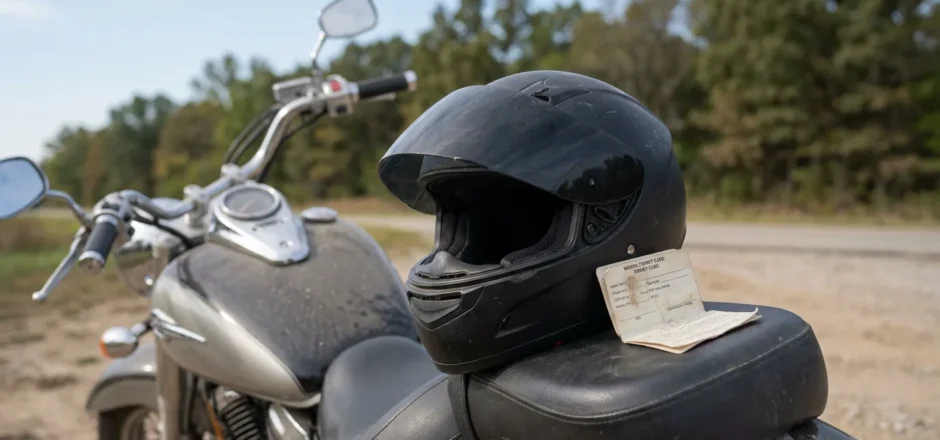
What Every New Rider in the Northland Should Know Before Skipping the Helmet
Key Takeaways: Riding on a Missouri motorcycle instruction permit cancels the helmet exemption, regardless of age or insurance. RSMo 302.026 allows riders 26 and older with qualifying medical insurance to ride without headgear, but that exemption applies to fully endorsed riders. RSMo 302.020.2 requires permit holders 26 or older to wear headgear whenever the vehicle is in motion. Missouri makes helmet rules uniform statewide, so Kansas City cannot change the requirement. A helmet violation carries only a small fine with no license points and does not automatically bar an injury claim, though insurers often raise it under Missouri’s comparative fault framework. Early action to preserve evidence may strengthen your position.
If you are riding on a Missouri motorcycle instruction permit, the helmet exemption generally does not apply to you. Missouri loosened its universal helmet rule in 2020, and many Kansas City riders assume anyone 26 or older can ride bare-headed. Under RSMo 302.020.2, a person 26 or older with an instruction permit "shall wear protective headgear at all times the vehicle is in motion."
If you were hurt in a crash while riding on a permit, our team at Ley de lesiones de Northland can explain what the helmet question means for your claim. Call us at 816-400-4878 o reach out to our team today for a straightforward conversation, backed by our 30-Day Satisfaction Guarantee.
Breaking Down the Missouri Motorcycle Helmet Law 302.026 Exemption
The exemption lives in RSMo 302.026, and its heading reveals how conditional it is. The statute is titled "Motorcycle operators twenty-six years of age or older, no protective headgear required, when, proof of insurance coverage required." That "when" matters. This is a carve-out that applies only when a rider meets every condition the legislature attached.
Two conditions control the missouri motorcycle helmet law 302.026 exemption. First, the rider must be at least 26 years old. Second, the rider must carry qualifying medical or health insurance coverage and prove it. The Revisor lists both 302.026 and 302.020 as effective August 28, 2020, when Missouri moved from universal helmet requirement to partial exemption.
The statute page itself directs permit holders elsewhere. En Missouri helmet exemption statute page includes a cross-reference: "Motorcycle operators with instruction permit, protective headgear required, 302.020." The state indicates permit riders are governed by a different provision. We covered the broader shift in an earlier post on how Missouri eased its helmet requirements.
Why a Permit Is Not the Same Credential as an Endorsement
A permit and Class M endorsement are different under Missouri motorcycle permit law. The exemption is built around riders who completed the licensing process. Permit holders have not, which explains why the helmet exemption disqualification applies to learner-stage riders.
How Missouri Riders Earn the M Endorsement
Missouri offers two paths to full endorsement. Riders who finish a Basic RiderCourse may present the completion card at any Missouri license office within a calendar year to obtain the M endorsement. Alternatively, riders may pass both written and riding skills tests at a testing office while satisfying other general licensing requirements.
How the Instruction Permit Works
The temporary motorcycle instruction permit under RSMo 302.132 is a learner’s credential. A person at least fifteen and one-half years old may apply with parental consent. The director issues the permit when the applicant has completed a motorcycle rider training course approved under sections 302.133 to 302.138 and is otherwise eligible.
The permit has a shelf life and restrictions. RSMo 302.132.3 provides a six-month highway operation period, with added limits for riders under sixteen:
- Engine displacement of no more than 250cc
- No riding from half-hour after sunset until half-hour before sunrise
- No carrying passengers
Permits can be renewed, allowing riders to remain in permit status beyond six months.
What This Means for a Permit Holder Over 26
Age alone does not restore the exemption for permit riders. A 40-year-old with a new permit is in the same helmet position as a 17-year-old learner. RSMo 302.020.2 requires headgear for operators and passengers under 26 and for permit-holding operators 26 or older whenever the vehicle is in motion.
| Rider Status | Age 26+ with Qualifying Insurance | Helmet Required? |
|---|---|---|
| Full Class M endorsement | Yes | Generally no, under RSMo 302.026 |
| Full Class M endorsement | No | Yes |
| Instruction permit holder | Yes | Yes, under RSMo 302.020.2 |
| Instruction permit holder | Under 26 | Yes |
💡 Pro Tip: Keep proof of qualifying health coverage with your registration. If you rely on the exemption and cannot produce documentation during a traffic stop, consequences can be frustrating. The statute says no one may be stopped solely to check helmet compliance.
Kansas City Ordinances Cannot Change the Rule
Missouri law makes helmet rules uniform statewide. RSMo 302.020.2 states: "No political subdivision of this state shall impose a protective headgear requirement on the operator or passenger of a motorcycle or motortricycle." Kansas City, Gladstone, Liberty, and North Kansas City cannot write their own helmet ordinances or loosen existing ones.
What Riding Without a Required Helmet Can Mean for an Injury Claim
A helmet violation does not automatically erase your right to recover, but it can complicate matters. Failing to wear required headgear is an infraction under RSMo 302.020, punishable by a fine of no more than twenty-five dollars, with no court costs and no points. Missouri follows pure comparative fault, so defense insurers may argue a rider’s conduct contributed to injury severity. In handling motorcycle cases across the Northland, we see adjusters raise the helmet issue early.
Whether that argument succeeds is fact-dependent. If a driver turned left across your path, helmet absence may have little to do with why the collision happened. Causation of the crash and causation of specific injuries are separate questions. Whether evidence of helmet nonuse is admissible can be contested. An experienced kc motorcycle accident attorney can push back when insurers blur that line.
Evidence gets stale quickly, making early action important. Scene photos, dashcam footage, witness information, and the bike itself carry information that disappears over time. Missouri’s civil filing deadlines are set by statute, vary by claim type, and are separate from any claims process. Courts interpret exceptions narrowly, so waiting rarely helps.
The Safety Case Behind the Statute
The medical community has long treated helmet law rollbacks as a public health concern. A commentary in Annals of Emergency Medicine questioned repealing universal helmet laws. That clinical perspective may help illustrate why lawmakers tied the exemption to full licensure rather than extending it to learners.
Missouri’s training program reflects the same instinct. State rider course students must bring a DOT helmet along with eye protection, gloves, long sleeves and pants, and over-the-ankle footwear. The state does not train new riders bare-headed.
💡 Pro Tip: If you wore a helmet during a crash, do not throw it away. A damaged helmet can be meaningful physical evidence about impact forces and injury mechanisms.
Preguntas frecuentes
1. Does the missouri motorcycle helmet law 302.026 exemption apply if I have a permit and I am 30?
Generally, no. RSMo 302.020.2 requires permit holders 26 or older to wear protective headgear whenever the motorcycle is in motion.
2. How long does a Missouri instruction permit last?
Under RSMo 302.132.3, the permit authorizes highway operation for six months, with renewal allowed. Riders under sixteen face additional restrictions on engine size, nighttime riding, passengers, and distance.
3. Can Kansas City pass its own helmet ordinance?
No. RSMo 302.020.2 prohibits political subdivisions from imposing protective headgear requirements, making the rule uniform statewide.
4. Will not wearing a helmet automatically bar my injury claim?
No. Missouri’s comparative fault framework may reduce recovery under certain circumstances, but the outcome depends on specific facts, injuries, how the crash occurred, and whether evidence is admissible.
5. Do I have to take the rider course to get an M endorsement?
Not necessarily. Riders may present a Basic RiderCourse completion card at a license office within a calendar year or pass written and riding tests, assuming other requirements are met.
Where This Leaves Missouri Riders
An instruction permit generally cancels the exemption while riding. The missouri motorcycle helmet law 302.026 exemption was written for fully endorsed riders 26 and older with qualifying coverage, and RSMo 302.020.2 removes permit holders from that group regardless of age. If you are a missouri learner permit rider, keep the helmet on. And if you were injured while riding, that detail is one piece of a larger picture involving liability, medical documentation, and how an insurer values your losses.
Our team has spent decades helping injured people in Clay, Platte, and Jackson Counties. With 50+ years of combined attorney experience, past recoveries in the $1.5M to $2M range in serious cases, recognition as Best of the Northland by the Courier Tribune, and Best Law Firm and Best Personal Injury Attorney honors from Kansas City Magazine, we handle catastrophic injury and wrongful death matters with the seriousness they deserve. Past results do not guarantee a similar outcome in any other case. Our clients tell us we talk to them, not at them. Reach out to Ley de lesiones de Northland en 816-400-4878 o schedule your free consultation and let us take the pressure off, with our 30-Day Satisfaction Guarantee standing behind the relationship.
Disclaimer: This content is for informational purposes only and is not legal advice. Every case is unique, and results may vary. Consult an attorney about your specific circumstances.