
 English
The Paperwork Trail That Can Change a Truck Crash Case
Key Takeaways: A driver qualification file is the federally mandated safety file a trucking company must keep on every commercial driver, containing the employment application, inquiries into the driver’s driving record and prior employment, a road test certificate or accepted equivalent, medical certification, and annual driving record reviews. Under 49 C.F.R. Part 391, carriers must verify that a driver is physically qualified, properly licensed, road-tested, and free of a disqualifying driving history before putting them behind the wheel. In a Kansas City truck accident claim, this file may help answer whether the driver should have been on the road at all, and gaps in it can potentially support negligent hiring, retention, or entrustment claims against the carrier itself, though Missouri law limits those direct claims in some situations, including where the carrier admits the driver was acting within the scope of employment. These records typically surface only through formal discovery, which is why early preservation letters and prompt requests for DQ files, driver logs, ELD data, and maintenance records matter. Missouri’s general personal injury deadline is five years under RSMo § 516.120(4), while wrongful death actions generally must be filed within three years under RSMo § 537.100, and claims against government entities can carry shorter deadlines and notice requirements. Acting quickly may help protect evidence that could otherwise cycle off carrier systems.
A driver qualification file is the personnel-style safety file a trucking company is federally required to keep on every commercial driver it puts behind the wheel. It generally holds the employment application, inquiries into driving record and prior employment history, a road test certificate or accepted equivalent, medical certification, and annual reviews of driving record. In a Kansas City truck accident claim, that file often speaks to a question the insurance adjuster may prefer you never ask: should this driver have been on I-35, I-435, or Highway 169 in the first place? When the file is thin, outdated, or missing pieces, it can potentially support a negligent hiring or supervision theory against the carrier itself, not just the driver, depending on the facts and how Missouri law applies.
If you or someone you love was hurt in a collision with a commercial truck, our team at Ley de lesiones de Northland is here to walk you through what these records mean and how we go after them. We talk to you, not at you, and keep you informed at every step. Call us at 816-400-4878 o reach out to our team today for a conversation about your situation.
What Federal Rules Require Carriers to Keep
Federal Motor Carrier Safety Regulations under 49 C.F.R. Part 391 require every motor carrier to maintain a driver qualification file for each driver it employs. The FMCSA’s safety planning guidance sets out the driver qualification file requirements under 49 C.F.R. § 391.51, including documents a company must collect before hiring and update throughout employment. These standards generally apply to interstate carriers rolling through Kansas City regardless of where the company is headquartered, subject to exemptions in Part 390 and § 391.2.
The purpose is straightforward: before a carrier hands over the keys to a vehicle that may weigh up to 80,000 pounds, it must generally verify the driver is physically qualified, properly licensed, road-tested, and free of a disqualifying driving history. FMCSA guidance applies a common framework across commercial vehicle operations, which is why much of this analysis translates to property-carrying truck claims, even though specific requirements can differ by operation type.
The Core Documents Inside a DQ File
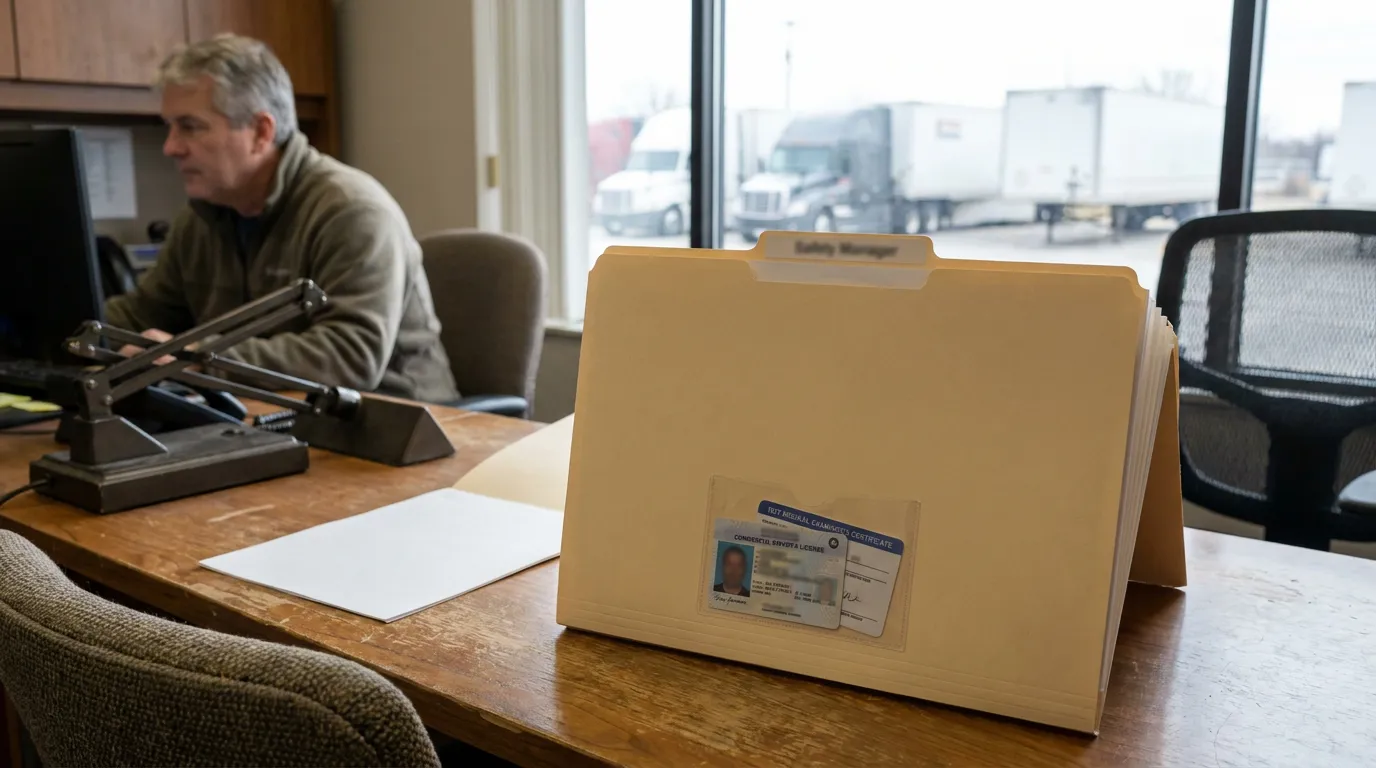
A complete file generally includes:
- The employment application, including prior employers and accident history
- Motor vehicle record (MVR) inquiries to each state where the driver held a license during the preceding three years
- A road test certificate or accepted equivalent, such as a valid CDL where the rules allow
- Documentation of current medical certification
- An annual review of driving record, along with a list or certificate of violations where still required
Each item exists for a safety reason. Each missing item is a question the carrier may have to answer under oath.
Missouri CDL Rules and the File
Missouri requires drivers operating commercial motor vehicles to hold a valid CDL matching the vehicle class and any required endorsements. The Missouri Department of Revenue’s page on commercial driver license classes explains the Class A, B, and C criteria and federal medical certification standards tied to CDL issuance and renewal. That license and its underlying medical certification are foundational items the carrier is expected to verify and document, tying state licensing directly to federal recordkeeping.
Why the Driver Qualification File Truck Accident Claim Analysis Matters
This kind of analysis shifts the focus from a single moment of driver error to the company’s decision-making over months or years. If the file shows the carrier hired someone with a pattern of moving violations, skipped the road test, or let medical certification lapse, those facts may support claims that the company was negligent in hiring, retaining, or entrusting the vehicle. Missouri law, however, limits when direct claims proceed: under decisions following McHaffie v. Bunch, if the carrier admits the driver was acting within the scope of employment, separate negligent hiring or entrustment theories are often barred, with narrow exceptions such as claims supporting punitive damages. Missouri courts may also consider violations of federal motor carrier safety regulations as evidence relevant to negligence, though whether a regulation establishes a standard of care depends on the rule, the facts, and the court.
Legal scholarship, including analysis in the Missouri Law Review, discusses how federal trucking safety regulations interact with state negligence doctrine and how plaintiffs use compliance records in discovery. These sources help explain the landscape, but controlling authority remains the statutes, regulations, and Missouri appellate decisions themselves.
💡 Pro Tip: Ask whether the carrier has issued a litigation hold. Some qualification-related documents may be purged on routine retention schedules once a driver leaves; Part 391 itself requires retention of certain records only for defined periods, such as three years after employment ends.
How These Files Surface in a Missouri Truck Crash Case
Driver qualification files typically come out through formal discovery, not in your mailbox. In a Missouri truck crash case, our team typically sends a preservation letter early, then requests the complete DQ file, driver logs, ELD data, maintenance records, and the carrier’s safety policies. We review each item against Part 391’s requirements, and gaps get followed up in depositions of the safety director and hiring manager.
Timing matters more than most expect. Drivers change employers, carriers reorganize, and electronic data can cycle off systems; ELD records, for example, carry comparatively short federal retention periods. Our guide on preserving truck accident evidence covers the categories that tend to disappear first.
Deadlines That Affect Your Right to Ask for These Records
Missouri’s civil filing deadline shapes how long you may have to bring the claim that unlocks this discovery. Under RSMo § 516.120(4), an action for injury to the person or rights of another, not arising on contract, must generally be commenced within five years. This applies to many personal injury claims, but not universally. Wrongful death claims fall under RSMo § 537.100, generally requiring filing within three years of death; claims involving public entities or certain contractual/statutory claims can carry shorter deadlines, and separate administrative notice requirements may apply when a government vehicle or entity is involved.
| Record type | Typically shows | Why it matters |
|---|---|---|
| MVR checks and annual reviews | Violations, suspensions, patterns | May support negligent retention |
| Medical examiner’s certificate | Physical qualification status | Lapses raise fitness questions |
| Road test certificate | Skills verification | Absence may suggest shortcuts |
| Employment application | Prior carriers, crash history | May reveal what the company knew |
Courts often interpret tolling and discovery-rule exceptions narrowly, though Missouri law does toll the limitations period in defined circumstances, such as for minor claimants. Because deadlines depend on the specific facts, parties, and theory of recovery, it’s wise to speak with counsel well before you think the clock runs out.
Common Challenges Families Run Into
Most people we meet after a serious truck collision have never dealt with a corporate defendant before, and the learning curve is steep. Carriers and their insurers often have counsel and investigators working the scene within hours, while the injured person is still in the hospital, and the first settlement offer may arrive before the full extent of injuries is known.
Another challenge is complexity of parties. A single Missouri truck crash may involve the driver, motor carrier, a freight broker, a maintenance contractor, and multiple insurance policies layered together. Sorting out responsibility takes time, documentation, and a willingness to pursue full available coverage rather than accept a quick resolution.
💡 Pro Tip: Keep your own file. Medical records, mileage to appointments, pay stubs showing lost income, and a short daily note about pain and limitations can become some of the most persuasive evidence in the case.
How Our Team Approaches Carrier Recordkeeping Issues
Our attorneys bring more than 50 years of combined experience to serious commercial vehicle cases, and we have recovered results in the $1.5 million to $2 million-plus range for clients facing catastrophic injuries and wrongful death losses. Voted #1 Accident Lawyer and Best of the Northland of Kansas City, we built this practice around the idea that people deserve to understand their own case. Past results do not guarantee or predict a similar outcome in any future case. Eric Bartlett has spent years volunteering across the Northland, and that same community-first mindset shows up in how we handle files.
When you work with a driver qualification file truck accident claim lawyer at our firm, we keep you informed about what we requested, what we received, and what it means. We also stand behind our 30-Day Satisfaction Guarantee, because trust should not be something you gamble on. Outcomes always depend on the specific facts, and we will tell you honestly what we see.
Preguntas frecuentes
1. What happens if the trucking company cannot produce a complete DQ file?
Missing or incomplete records may support an argument that the carrier failed to meet federal qualification standards. Courts may also consider whether records were destroyed after a duty to preserve arose, and Missouri courts have discretion in deciding what sanction or adverse inference, if any, is appropriate. Consequences vary by case and judge.
2. Can the file alone prove the trucking company was at fault?
Generally, no. A deficient DQ file is one piece of evidence among many, and you still generally have to show that the failure caused the crash and your damages. It tends to work best alongside logs, ELD data, maintenance records, and crash reconstruction.
3. How quickly should I contact a truck crash attorney in KC?
As soon as you reasonably can. Even though Missouri’s general personal injury deadline is five years under RSMo § 516.120(4), and some claims have shorter deadlines, electronic data and some carrier records may not survive that long without a preservation demand.
4. Does a driver qualification file apply to out-of-state carriers driving through Missouri?
Yes, in most cases. Part 391 requirements are federal and generally apply to interstate motor carriers regardless of where the company is based, including those traveling through Kansas City, subject to exemptions for certain drivers and operations.
5. What if my family member did not survive the crash?
Wrongful death claims follow a different statutory framework in Missouri under RSMo §§ 537.080 and 537.100, with their own deadline and rules about who may bring the claim and in what order of priority. We can explain how those provisions may apply to your family’s circumstances.
Bringing It All Together
A driver qualification file is not just paperwork. It’s a documented record of whether a trucking company took its safety obligations seriously before a crash ever happened, and under Missouri negligence law combined with federal motor carrier standards, that record can matter enormously. Reviewing it carefully, requesting it promptly, and understanding what its gaps may mean are all part of building a claim that reflects the true scope of what you have lost.
You do not have to sort through federal regulations and insurance adjusters on your own. Our team at Northland Injury Law is ready to listen, explain your options in plain language, and go after the records that tell the real story. Call 816-400-4878, schedule your free consultation now, or learn more about how we serve Northland families on our firm’s main page. Don’t wait. Get the answers you deserve.
Disclaimer: This content is for informational purposes only and is not legal advice. Every case is unique, and results may vary. Consult an attorney about your specific circumstances.